


If the pump fails to deliver fluid, it does not necessarily mean that it is idling; cavitation can still occur even when there is fluid in the pump.
When diagnosing pump failures on-site, cavitation, gas lock, and no-load operation are often confused with one another. All three types of failure may manifest as reduced flow, abnormal pressure, vibration, or temperature rise, but their underlying failure mechanisms are entirely different.
Cavitation occurs when a liquid vaporizes in a low-pressure zone; gas lock occurs when accumulated gas disrupts normal flow; and idle operation occurs when the pump continues to run despite a lack of liquid.
It may appear that the fluid is not being pumped in, but the actual troubleshooting approach may be different.
Ⅰ Cavitation: Low-pressure vaporization
Cavitation commonly occurs near the suction inlet of centrifugal pumps.
Once the impeller begins rotating, the pressure at the inlet decreases. When the pressure falls below a certain level, the liquid undergoes localized vaporization, forming numerous small bubbles.
These bubbles travel with the liquid into the impeller and rapidly rupture upon entering the high-pressure zone. Over time, pitting appears on the impeller inlet and blade surfaces; in severe cases, honeycomb-like erosion pits can be observed.
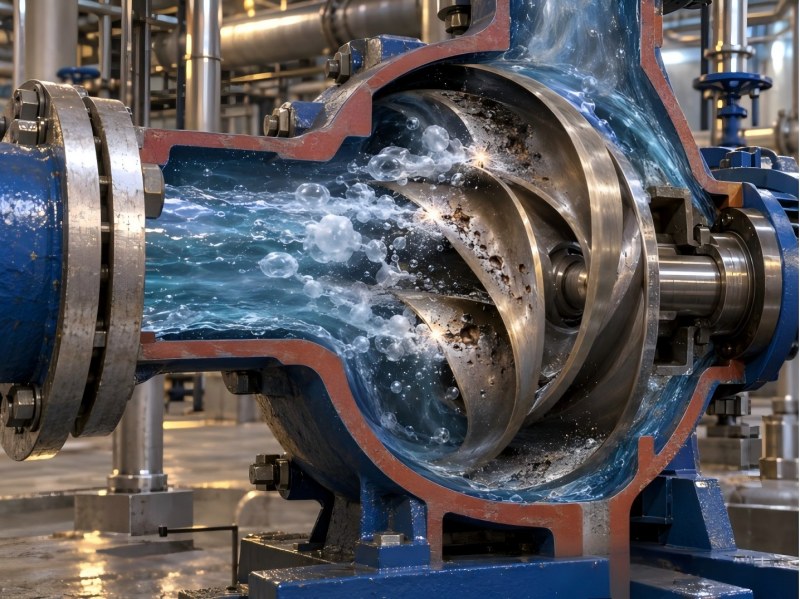
Listening to the sound of cavitation at the site, it sounds somewhat like sand entering a pump, producing continuous pitting and rustling impact noises. At the same time, the pump's vibration will increase, while its flow rate and head may also decrease.
When this situation occurs, the first thing to check is whether the liquid level on the suction side is too low; whether the inlet valve is fully open; whether the filter is clogged; whether the suction line is too long or has too many elbows; whether the medium temperature is too high; and whether the pump has entered a flow range that is too high.
Cavitation has a distinct characteristic: there is still liquid inside the pump, and the pump can still operate, but its operating condition is no longer normal.
In engineering practice, when assessing this type of issue, NPSHa and NPSHr are also verified. If the available NPSHa at the inlet is insufficient, the risk of cavitation increases significantly.
Ⅱ Gas Lock: Gas Accumulation Inside the Pump
Gas stripping and cavitation are not the same thing.
Air lock commonly occurs during the startup phase of a centrifugal pump. When excessive air remains in the pump chamber or suction line, the impeller may rotate, but the fluid inside consists primarily of gas; consequently, the pump cannot effectively transport the liquid, and it becomes difficult to establish a normal pressure differential.
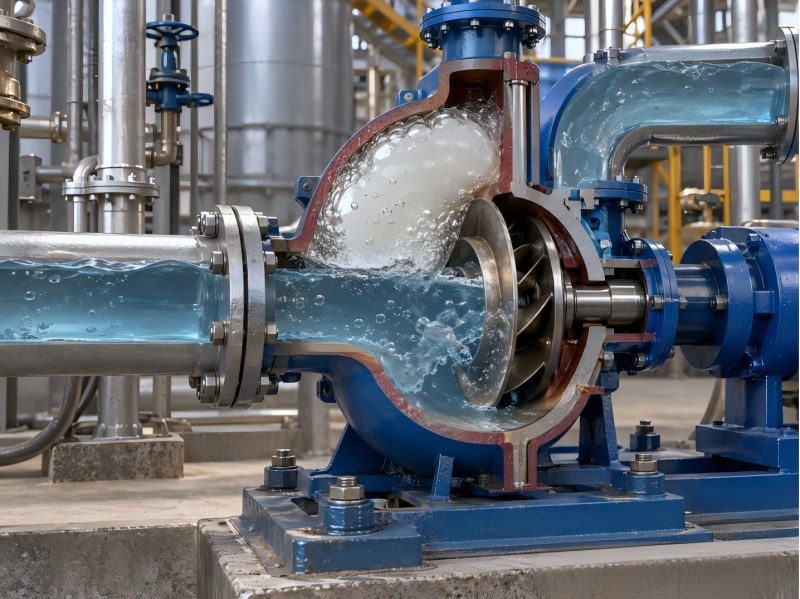
The on-site behavior is quite straightforward: the motor is running, there is little pressure at the outlet, and the flow rate cannot increase.
At this point, if the pump is stopped to purge air, then refilled, and the fluid flows normally again after restoration, the issue should generally be investigated as a gas lock.
Common causes include failure to fully prime the pump before startup, gas accumulation at the high points of the pump casing, leakage at the suction pipe connections, liquid backflow after pump shutdown, inadequate closure of the check valve, the formation of air pockets due to pipeline layout, or the release of gas during medium operation.
In gas stripping, the "gas" often refers to air leaking in from the outside or to gases that have been released from the medium.
The bubbles in cavitation are formed when the liquid vaporizes in a low-pressure region.
When distinguishing between these two issues on-site, merely hearing that "there is air in the pump" is not enough; it is also necessary to determine how the air entered the system.
Ⅲ No-load operation: operation with insufficient fluid
No-flow operation is easier to understand: the pump is still running, but no normal liquid is entering it.
For example, when the water tank is emptied, the level interlock fails to activate; the inlet valve remains closed while the pump is still running; the suction line becomes disconnected; or the foot valve fails, causing all the liquid in the pump to backflow.
This operating condition has a significant impact on the mechanical seal.
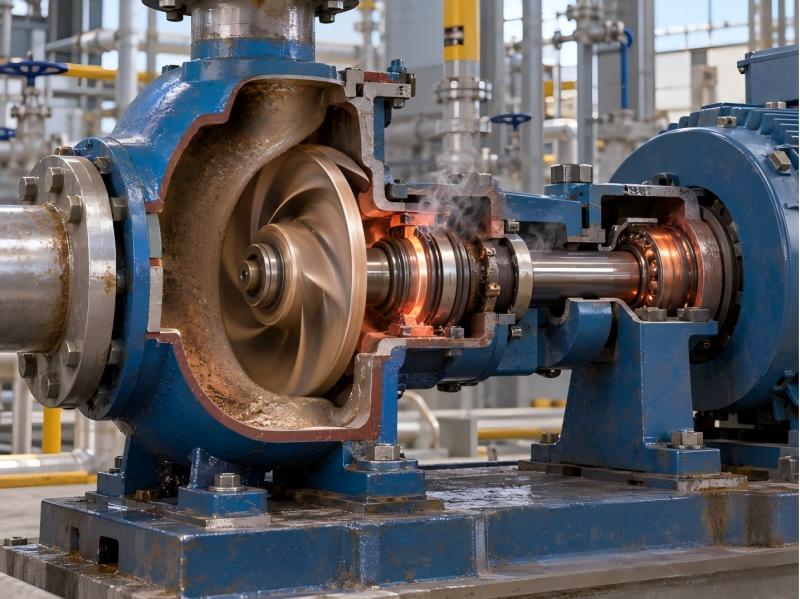
Mechanical seals generate heat during operation; under normal conditions, this heat is dissipated through lubrication by the medium and heat removal. Once the fluid supply is interrupted, the end-face temperature rises rapidly. After a relatively short period, the sealing ring, rubber components, and sliding bearings may all develop problems.
Magnetic pumps and shielded pumps are also relatively sensitive to operation with insufficient fluid; some of their internal components rely on the transported medium for cooling and lubrication.
Common on-site symptoms during no-load operation include zero flow at the outlet, rapid temperature rise in the pump casing or sealing areas, light motor load, current that may be lower than during normal operation, or leakage or abnormal noise appearing after the unit has been running for some time.
It should be noted that current can only be used as a supplementary indicator for diagnosis. Depending on the pump type and operating conditions, current variations differ; therefore, a low current reading alone should not be taken as definitive evidence of no-load operation.
Ⅳ How to differentiate among the three scenarios on-site
If the pump can still draw liquid normally but exhibits high noise and vibration, with a distinct impact sound at the impeller position, cavitation should be investigated first.
If the pump fails to draw in fluid after startup and pressure cannot be established, but pressure is restored after venting and priming, the condition is typically caused by air lock.
If the suction side has run dry while the pump continues to operate, causing the pump body and seals to begin heating up, treat the situation as a no-load condition.
Three key issues can be identified on site: Is there still liquid in the pump? Are the normal flow rate and pressure present? Is the gas entering from the outside, or has the liquid vaporized in the low-pressure zone?
By addressing these three questions, it is generally possible to distinguish between cavitation, gas lock, and idle operation.
Ⅴ How to Handle It
Cavitation requires addressing the suction conditions.
Clean the filter, inspect the inlet valve, reduce suction resistance, raise the liquid level, and lower the medium temperature; if necessary, also verify whether the pump's model selection and operating point are appropriate.
For gas purging, accumulated gas and gas leaks must be addressed.
Inspect the inhalation tube flange, fittings, valves, and sealing points; before startup, fill the pump to its full capacity, and ensure that any areas where air may accumulate at the highest points are vented.
During idle operation, ensure that liquid deficiency protection is implemented.
Liquid level, flow rate, pressure, and current can all serve as interlock signals. Which one should be used depends on the on-site operating conditions and the type of pump; it cannot rely solely on operators monitoring the process.
Ⅵ Key Points
Cavitation: The local vaporization of a liquid.
Gas lock: Gas is present, preventing liquids from entering.
No-flow operation: The pump is still rotating even though there is no fluid.
Cavitation often damages the impeller; gas-driven operation can easily prevent liquid intake, while idling can readily damage the seals and components that require medium lubrication.
If you encounter a pump abnormality on site, don't be in a hurry to attribute the problem entirely to "air intake." Check whether there is liquid at the inlet, whether there is pressure at the outlet, and then listen to the sound coming from the pump; this will make the diagnosis much faster.



 IPv6 network supported.